Every Sacred River Is Choking: How Cold Plasma Technology Could Help Heal India's Seven Holy Rivers
Vinod Patil
August 27, 2026
India’s seven sacred rivers face severe pollution from untreated sewage and industrial waste. Discover how cold plasma technology could help treat wastewater, eliminate pathogens, recover nitrogen, and support a cleaner, more sustainable future for the Ganga, Yamuna, and other holy rivers.
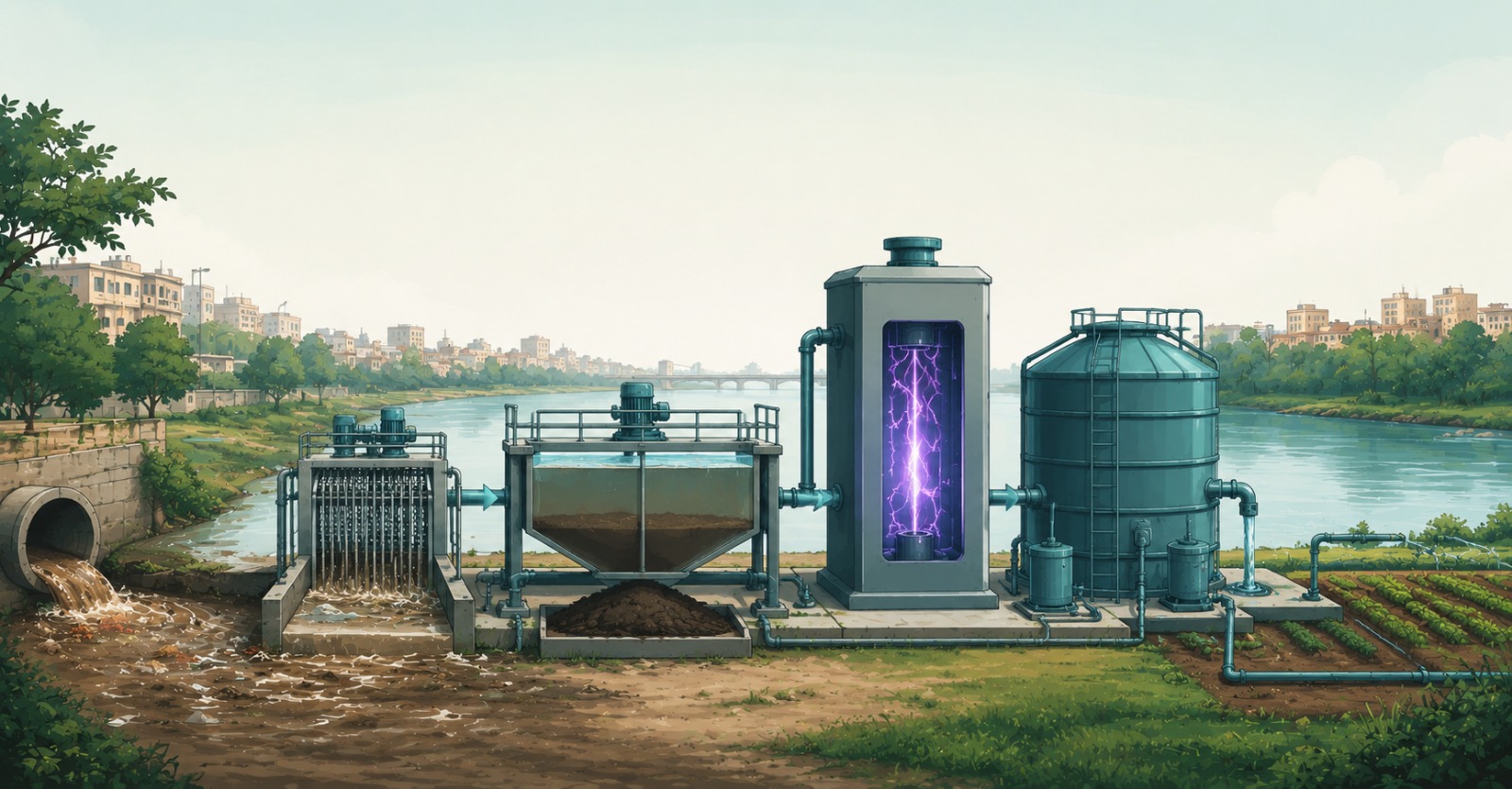
India's seven sacred rivers — the Ganga, Yamuna, Godavari, Saraswati, Narmada, Sindhu, and Kaveri, together revered in scripture as the Sapta Nadi — are not water bodies to the people who live beside them. They are mothers, goddesses and the final destination of every prayer. Untreated sewage is now a problem common to nearly every one of them, from the Ganga's glacial source in the Himalayas to the Kaveri's delta in the south. A dip in their waters is believed to wash away sin. A sip is tirth, sacred communion.
That belief is now colliding with a harder truth: the water itself is often unsafe to touch.
The gap between faith and fact->
In Haridwar — one of the holiest bathing points on the entire river — the Central Pollution Control Board has confirmed that Ganga water fails India's own bathing-water standard, with biological oxygen demand levels running well above the safe limit. Downstream in Delhi, the Yamuna regularly turns into a river of toxic white foam during festival season. In one widely reported incident, a woman was filmed washing her hair in that foam during Chhath Puja rituals — visibly unaware of the ammonia and phosphate load she was standing in. The Delhi High Court, presented with the same problem, refused to permit ritual bathing in the river that year, telling devotees plainly that entering the water would make them sick.
This isn't isolated to two rivers. Nationally, Indian cities generate roughly 72,000 million litres of sewage every single day. The country's installed treatment capacity covers less than half of that, and what actually gets treated — after accounting for plants that are broken, under-maintained, or simply switched off to save power — is closer to 28%. The remaining 70-plus percent flows, untreated, into the same rivers that carry the weight of a billion people's faith.
Even Uttarakhand's government has admitted, in submissions to the National Green Tribunal, that sewage treatment plants near the Ganga's own point of origin in the hills are failing compliance checks. If the river is compromised near its glacial source, everything downstream inherits the problem.
Why "just build more STPs" hasn't been enough->
India isn't short on sewage treatment plants on paper — it's short on plants that actually run at their rated efficiency, are maintained, and are matched to real (not 2001-census-era) population loads. Studies have found actual sewage discharge into the Ganga running over 100% higher than official estimates, because planning still leans on outdated numbers. Add erratic power supply, silted aeration tanks, and years-long project delays under national schemes like AMRUT 2.0, and you get a treatment system that looks adequate in a government report and fails at the ghat.
This is the opening for a different kind of intervention: one that doesn't wait for a mega-STP to be built, funded and maintained for a decade, but that can be deployed at the scale of a single ghat, drain or town cluster — and pay for itself.
A multi-stage answer: filtration, then plasma->
Here's a treatment sequence that's technically sound and increasingly proven at pilot scale:
Stage 1 — Coarse filtration and sediment pressing. Wastewater is passed through screens and a press to strip out solids, silt, and mud — the same physical debris that already makes river water at crowded ghats look and smell unfit for tirth.
Stage 2 — Fine filtration. A second, finer filtration pass removes suspended particles and much of the heavy-metal-bearing sediment, using standard coagulation and adsorption techniques. This stage — not the plasma reactor — is what should be credited with pulling out heavy metals; it's important to be precise about that division of labour so the technology claim stays honest.
Stage 3 — Cold plasma treatment. The pre-filtered water is passed through a cold (non-thermal) plasma reactor. High-voltage discharge energizes air into reactive oxygen and nitrogen species. These reactive species do two things simultaneously: they destroy pathogens and break down organic pollutants (the same job a conventional STP does, but chemical-free), and they convert dissolved nitrogen into plant-available nitrate and nitrite. This isn't speculative — researchers, including a University of Alberta team publishing in Green Chemical Engineering, have already demonstrated exactly this "plasma-activated water" pathway, turning wastewater into a nutrient solution that supports crop growth, using only air and electricity, with a version already piloted on solar power.
Stage 4 — Two possible outputs.
• Route A — Fertigation. The nitrate-rich output is used directly by nearby farms or concentrated into a solid organic-nitrogen product, cutting demand for synthetic urea.
• Route B — River-safe release. The output is instead tuned toward a lower-nitrate, higher-oxidative (high-ROS) profile suitable for direct release back into the river, reducing the pollutant and pathogen load reaching bathing ghats.
Why this deserves serious pilot investment, not just applause->
The honest caveat: today's plasma-activation systems operate at pilot and hydroponic scale — thousands of litres a day, not the hundreds of millions of litres a single Ganga-front town produces. This is not a reason to dismiss the idea; it's a reason to deploy it the right way — as a decentralized, modular layer installed ghat-by-ghat and drain-by-drain, in parallel with fixing conventional STPs, rather than as a single silver-bullet plant meant to treat an entire river basin.
Done this way, the economics start to work in the technology's favour: it needs only air and electricity (increasingly solar), it slots into existing drains and irrigation lines rather than requiring a new treatment facility from scratch, and it produces a revenue stream — fertilizer or fertigation water for farmers — instead of only a cost.
The stakes are not abstract->
When a court has to tell devotees they cannot enter their own sacred river because it will make them ill, something fundamental has broken — not in belief, but in infrastructure. The rivers were never the problem. What we've allowed to flow into them is.
Faith moved millions of people to build temples on these banks for centuries. It's time faith and engineering pulled in the same direction — filtering, treating and returning these rivers to a state where a devotee's dip in Maa Ganga is once again just that and nothing more.
## Sources
- Outlook India, *"Sin-Cleanser Ganga In Haridwar Unfit Even For Bathing, Says Pollution Control Board"* — CPCB water-quality findings for Haridwar (BOD, coliform levels): https://www.outlookindia.com/national/sin-cleanser-ganga-in-haridwar-unfit-even-for-bathing-says-pollution-control-boa-news-298956
- Deccan Herald, *"Ganga water quality of bathing standard says govt"* — CPCB 2021 data and Namami Gange Programme STP project figures: https://www.deccanherald.com/india/ganga-water-quality-of-bathing-standard-says-govt-1091202.html
- CAG of India, *Chapter 4: Water Quality Monitoring of River Ganga* — CPCB/UKPCB STP compliance testing methodology: https://cag.gov.in/uploads/download_audit
_report/2025/9-Chapter-4-Water-Quality-Monitoring-
069b02017247de6.47310107.pdf
- EurekAlert!, *"Microbubble-enhanced cold plasma activation transforms wastewater into green liquid fertilizer"* — University of Alberta MB-CPA research summary:
https://www.eurekalert.org/news-releases/1128744
- ScienceDirect, Zhang et al., *"Microbubble-enhanced cold plasma activation of food-industry wastewater for valorization and hydroponic crop production," Green Chemical Engineering* (2026) — peer-reviewed study with performance data (COD reduction, nitrogen yield): https://www.sciencedirect.com/science/article
/pii/S2666952826000191
- The Western Producer, *"Cold plasma bubbles may turn wastewater into valuable crop input"* — plain-language explainer of the MB-CPA process: https://www.producer.com/crops/cold-plasma-bubbles-may-turn-wastewater-into-valuable-crop-input/
*Note: figures on national sewage generation (~72,000 MLD), treatment capacity gaps, and the Yamuna foam/Delhi High Court episode are drawn from widely reported CPCB and news coverage; if this article is published, I'd recommend re-verifying and linking the specific CPCB National Inventory report and the exact Delhi HC order/date before it goes to print, since I wasn't able to pull the original documents for those two claims in this pass.*
𝗘𝘃𝗲𝗿𝘆 𝗦𝗮𝗰𝗿𝗲𝗱 𝗥𝗶𝘃𝗲𝗿 𝗜𝘀 𝗖𝗵𝗼𝗸𝗶𝗻𝗴: 𝗛𝗼𝘄 𝗖𝗼𝗹𝗱 𝗣𝗹𝗮𝘀𝗺𝗮 𝗧𝗲𝗰𝗵𝗻𝗼𝗹𝗼𝗴𝘆 𝗖𝗼𝘂𝗹𝗱 𝗛𝗲𝗹𝗽 𝗛𝗲𝗮𝗹 𝗜𝗻𝗱𝗶𝗮'𝘀 𝗦𝗲𝘃𝗲𝗻 𝗛𝗼𝗹𝘆 𝗥𝗶𝘃𝗲𝗿𝘀
Every year, millions of people step into India's seven holy rivers — Ganga, Yamuna, Godavari, Saraswati, Narmada, Sindhu, Kaveri — believing the water washes away sin.
The uncomfortable truth: in many stretches, it's not even safe to touch.
In Haridwar, CPCB's own data shows Ganga water fails India's bathing-water standard. In Delhi, the Yamuna regularly turns into toxic white foam during festival season — bad enough that the Delhi High Court once refused to permit ritual bathing, warning devotees it would make them sick. Nationally, Indian cities generate ~72,000 million litres of sewage a day. Less than 30% actually gets properly treated. The rest goes straight into the rivers we call our mothers.
The problem isn't a lack of sewage treatment plants on paper — it's plants that are underpowered, under-maintained or built for population numbers that are decades out of date.
Here's a solution worth piloting seriously - 𝗖𝗼𝗹𝗱 𝗣𝗹𝗮𝘀𝗺𝗮 𝗧𝗿𝗲𝗮𝘁𝗺𝗲𝗻𝘁.
How it works:
1. Coarse filtration removes solids and silt.
2. Fine filtration strips heavy metals and suspended particles.
3. A Cold (Non-Thermal) Plasma reactor uses high-voltage discharge to energize air into reactive oxygen and nitrogen species — killing pathogens, breaking down organic pollutants and converting nitrogen into plant-usable nitrate/nitrite
4. The output goes one of two ways: fertigation water for farms or a cleaner, river-safe release with low nitrate content.
This isn't theoretical. A University of Alberta team (published in Green Chemical Engineering) has already demonstrated this exact pathway — turning wastewater into a nutrient-rich solution using only air and electricity, with a solar-powered version already piloted.
The honest caveat: today's systems run at pilot/hydroponic scale — thousands of litres a day, not the hundreds of millions a single Ganga-front town produces. That's not a reason to dismiss it. It's a reason to deploy it the right way - decentralized, modular, ghat-by-ghat and drain-by-drain — alongside fixing conventional STPs, not instead of them.
Done right, it's self-sustaining - needs only air and electricity (increasingly solar), slots into existing drains and irrigation lines and creates a revenue stream through fertilizer instead of only a cost.
When a court has to tell devotees their own sacred river will make them sick, something has broken — not in faith, but in infrastructure.
It's time faith and engineering pulled in the same direction #Ganga #RiverPollution #CleanGanga #WaterTreatment #Sustainability #ColdPlasma #GreenTech #CircularEconomy #NamamiGange #India #ClimateAction #WaterCrisis #Innovation #ESG #EnvironmentalEngineering #GreenNitrogen, #NitrogenFixation, #PlasmaActivatedWater, #ReactiveNitrogenSpecies, #GreenAmmonia, #SustainableAgriculture, #Fertigation, and #CleanTech